Billy Stroud
Dark Lies the IslandBilly Stroud is an ex-Marxist, a timetable obsessive, and a committed Real Ale Club member whose comic precision sits alongside serious convictions. He measures trains down to the second, argues over how beer should be scored, and resists easy judgments about both ale and political language. In a club given to drinking and shared ritual, he is the figure who insists on distinctions: between one minute and another, one beer and another, and between the people included in a name and those it leaves out.
Identity and Club Life
Billy belongs to the Real Ale Club, whose members travel together on drinking outings and understand themselves as hobbyists rather than merely a group of drinkers. On the journey to Llandudno, he offers no opinion about the resort itself; his attention is on the train timetable. That refusal to join the conversation about the destination is characteristic of his focus: while the others speculate about the town’s fortunes, he attends to what can be measured.
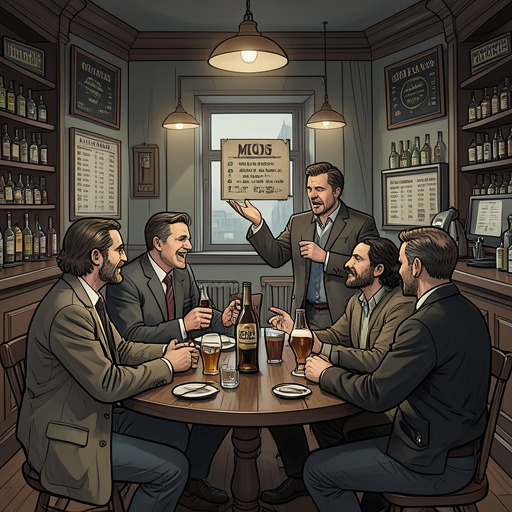
The club’s sociability gives Billy room for his habits without turning them into a source of serious friction. The members joke, drink, and argue, but their outings are described as civilised rather than aggressive. Billy’s precision is part of that shared culture, even when it makes him the butt of a joke or the obstacle to a quick consensus.
Timetables and the Comedy of Precision
On the train, Billy announces that it is two minutes and fifty seconds late leaving, then predicts that he will become an exotic dancer if it reaches Llandudno at 1:55 p.m. The precise delay and the extravagant wager make his timetable-keeping comic: the accuracy of his measurement is matched by an absurdly theatrical consequence. Elsewhere on the same journey, he listens to radio news through an earpiece and reports that the temperature is expected to reach 36.5 degrees Celsius. He continues to monitor information even amid the club’s drinking, food, and banter.
His attention to schedules is also a recurring counterpoint to the club’s easygoing atmosphere. Aboard a train where the group has brought a crate of Marston’s Old Familiar, Billy tracks minutes while others look out at the scenery or settle into the outing. The detail does not make him an outsider; rather, it supplies one of the group’s comic rhythms, a reliable measure against which the excursion’s looseness can play.
Beer, Judgment, and the Club’s Rules
Billy’s precision extends from timekeeping to taste. The Real Ale Club’s Merseyside branch has departed from the National Beer Scoring System, which rates beer from zero to five, and adopted its own zero-to-ten scale. The national scale distinguishes everything from beer that can be sent back to a rare five worthy of only a handful of brews over a lifetime. The branch’s expanded scale allows finer judgments: a hoppy tang might lift a beer from seven to eight, while the contribution of good oak casking could raise it further.
Billy had argued for decimal scoring, including marks such as 7.5 and 8.5, but the branch drew a line at ten whole points. The distinction captures his characteristic impulse to refine a system beyond its agreed limits. The national organisation responds badly to the branch’s altered reports, and the club faces the possibility of losing its charter. Billy’s proposal is therefore more than a private quirk: the members’ preferred language of evaluation puts their institutional standing, festival invitations, and branch history at stake.
When asked to name his all-time favourite beer, Billy rejects the premise as ridiculous. There is too much wonderful ale on the island, he argues, to separate Pelham High Anglican from Warburton’s Saxon Fiend, and the question has not even accounted for Belgian, Czech, Polish, or German brewing. He defends Paulaner Weissbier against a club member’s dismissal of German beer as gassy pop. His answer is both playful and principled: connoisseurship, for Billy, means refusing a simple ranking when the field is too varied to flatten into one winner.
Political Language and the Mainland
Billy also brings his analytical habits to political talk. On a journey through the north of England, he launches into a discussion of Ceauşescu and says that, as the moment recedes in memory, the critical instant seems increasingly like Romania. When another member asks what he means, the surviving exchange signals Billy’s readiness to pursue an argument in the midst of ordinary club conversation.
A different exchange gives his precision a sharper political edge. Steven objects to the phrase mainland campaign because it appears to erase the people to whom the word mainland is applied. Manus explains that the term means the rest of the United Kingdom in contrast to Ulster, not the Republic of Ireland; Billy’s contribution, as recounted in the passage, is the warning not to let emotion cloud clear thought. The terminology matters because it assigns a centre and a periphery: the people designated as mainland become an afterthought within the label. Billy’s intervention belongs to a conversation about the stakes of naming, not just a disagreement over wording.
Narrative Function
Billy’s defining traits emerge through recurring contrasts. His exact calculations coexist with a drinking club’s hangovers and laughter; his attempt to make beer scoring more exact meets institutional resistance; and his broad appetite for different brewing traditions frustrates the demand for a single favourite. These contrasts make him more than a one-note pedant. He is comic because he insists on precision in convivial, unruly settings, but that same insistence supports his ability to notice when a category is too crude or a name leaves someone out.
His varied appearances also connect the book’s social registers. In the Real Ale Club scenes, he is the timetable watcher and beer critic whose proposals risk the branch charter. In the political exchange about the mainland, the same preference for clear distinctions enters a discussion of national identity and exclusion. The book does not resolve these strands into a single account of his character; instead, Billy’s recognizable habits recur across separate settings, allowing punctuality, connoisseurship, and political exactness to illuminate one another.